Action Project — Project ALT
Universally Accessible and Culturally-Rooted Education for
Inclusive Climate Action, Disaster Risk Reduction, and Environmental Protection
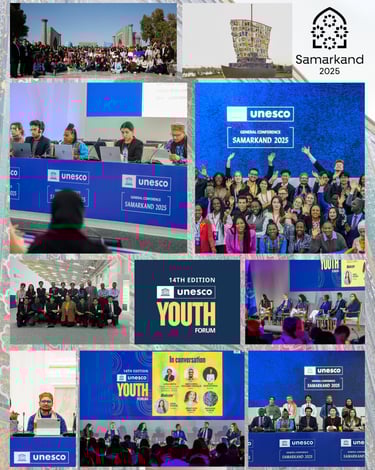
14th UNESCO Youth Forum 2025: Youth-Led Action Project – From Dialogue to Implementation
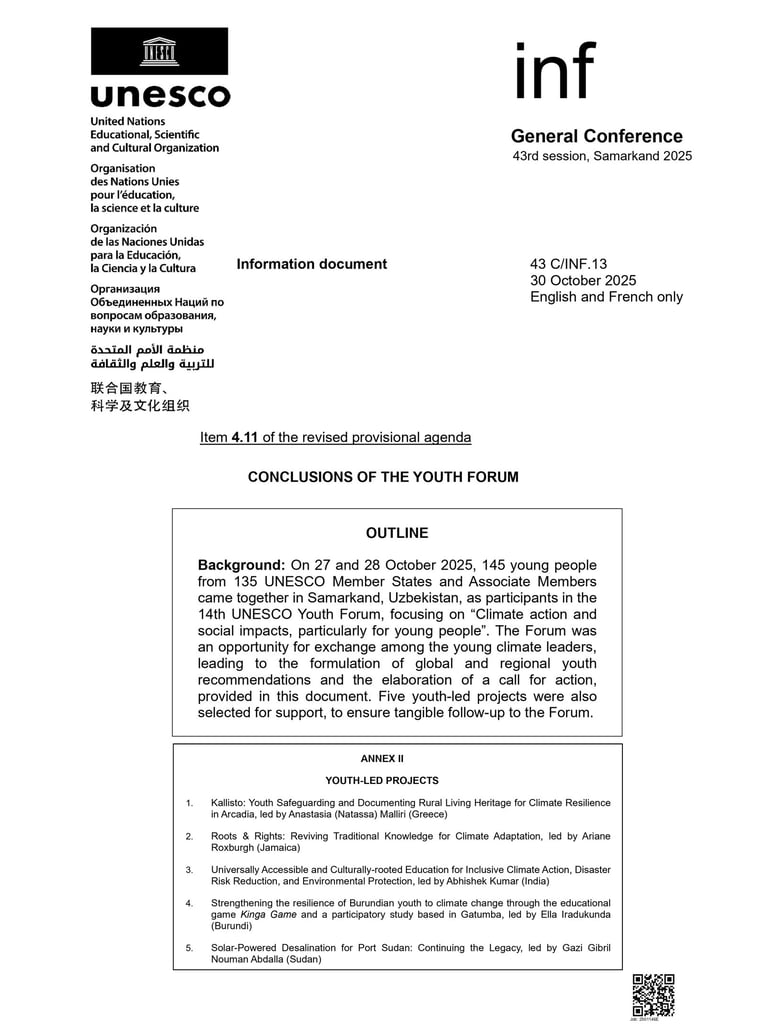
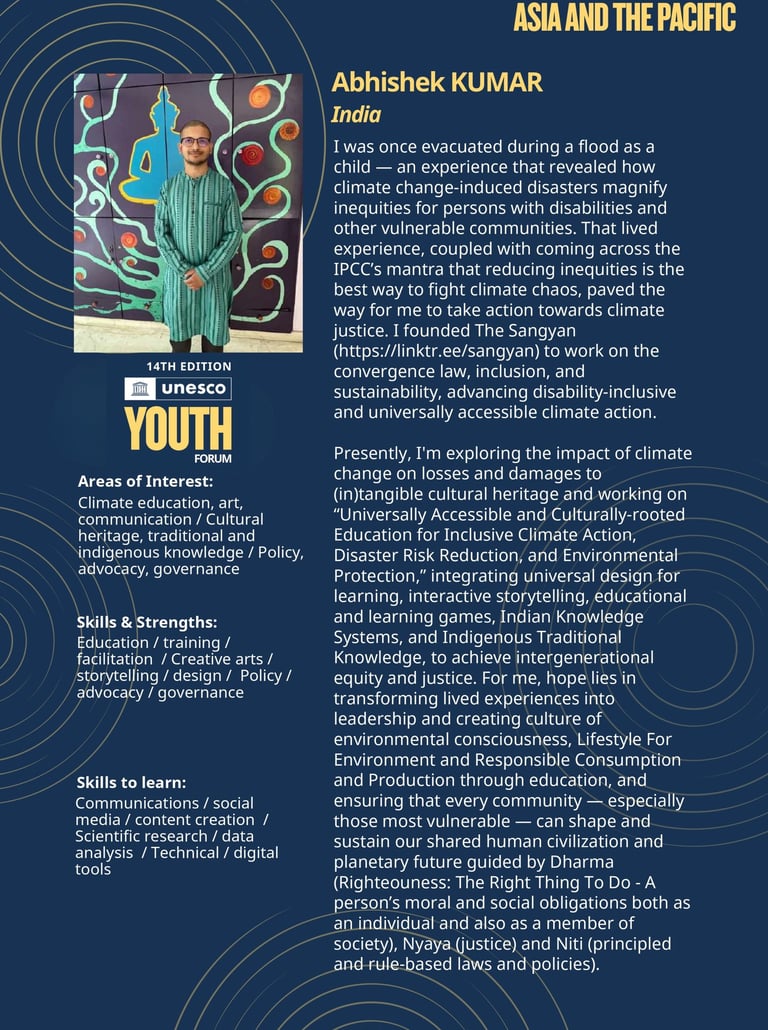
14th Edition of the UNESCO Youth Forum 2025 — “Climate Action and Social Impacts, Particularly for Young People” (Samarkand, Uzbekistan, from 27–28 October 2025): Selection of action project — “Universally Accessible and Culturally-rooted Education for Inclusive Climate Action, Disaster Risk Reduction, and Environmental Protection” by UNESCO as one of the five youth-led projects for follow-up and support (Annex II of the Conclusions of the 14th UNESCO Youth Forum 2025, Page 22).
This initiative builds upon years of endeavours at The Sangyan — advancing universally accessible and culturally resonant climate education to ensure inclusive climate action, disaster risk reduction, and environmental protection. The project aims to: Integrate universal accessibility and innovative approaches (like storytelling, roleplays, educational and learning games, etc.) in climate education architecture, embed Indigenous Traditional Knowledge and Indian Knowledge Systems, and enable and empower vulnerable communities through education to build resilient, climate justice, and intergenerational equity. Implementing this action project with the support of UNESCO and other stakeholders, to catalyse, nudge, and trigger meaningful and sustainable change. Together, we move from policy to practice — ensuring no one is left behind in the global climate transition.
The Action Project, “Universally Accessible and Culturally-Rooted Education for Inclusive Climate Action, Disaster Risk Reduction, and Environmental Protection,” led by Adv. Abhishek Kumar from India, Founder and Curator of The Sangyan, is embedding the mantra that the "best way to give effective and lasting protection from climate chaos is through action that addresses inequities such as those based on gender, ethnicity, disability, age, location, and income". It envisions education as both an enabler and an equaliser in the face of the global climate crisis. It seeks to bridge the often-separated realms of culture and accessibility—rooting climate action within local wisdom while ensuring universal inclusion through design and policy.
By uniting accessibility with cultural rootedness, the project advances a comprehensive vision of climate education that is inclusive, equitable, and transformative — aligning with the timeless value of Vasudhaiva Kuṭumbakam (One Earth, One Family, One Future).
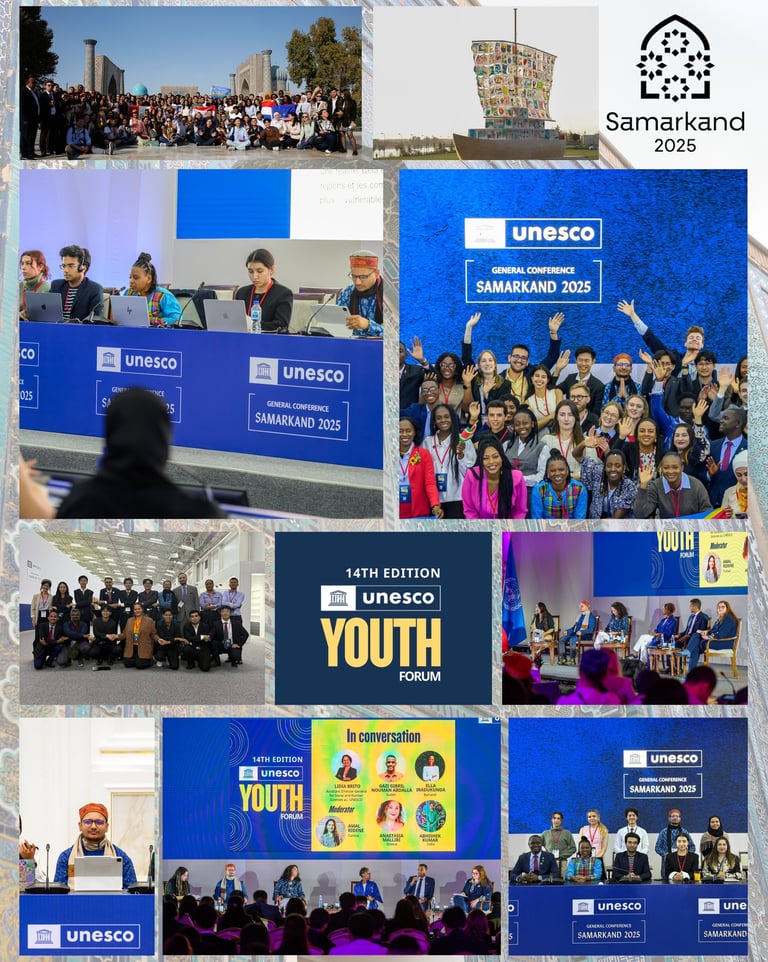
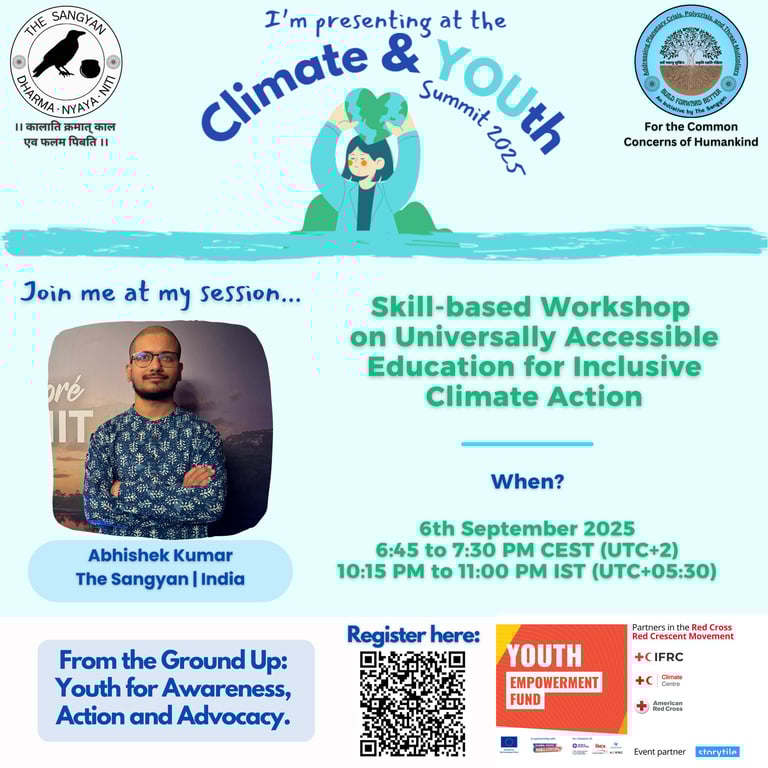
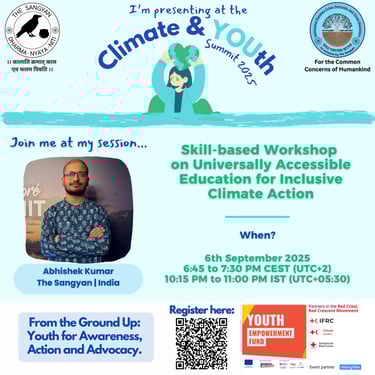
Skill-based Workshop on Universally Accessible Education for Inclusive Climate Action
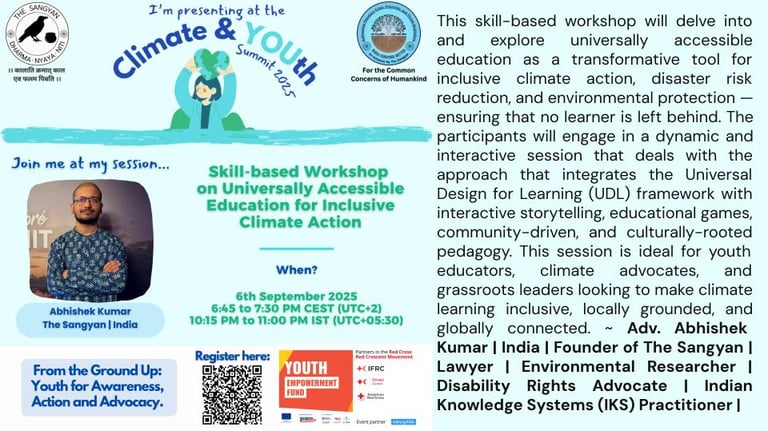
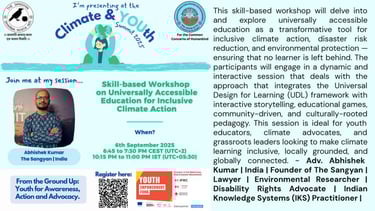
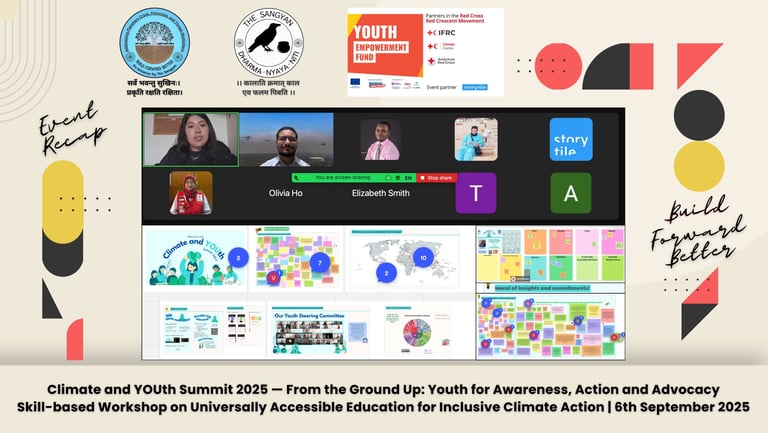
Plenary Session of the ‘Climate & YOUth Summit 2025 — From the Ground Up: Youth for Awareness, Action and Advocacy’
The Climate & YOUth Summit 2025 — From the Ground Up: Youth for Awareness, Action and Advocacy provided a global platform to highlight inclusive and transformative approaches to climate action. At the plenary session, Adv. Abhishek Kumar from India, representing The Sangyan, organised and facilitated a skill-based workshop on “Universally Accessible Education for Inclusive Climate Action.” This interactive session explored education as a force multiplier for inclusive climate action, disaster risk reduction, and environmental protection — ensuring that no learner is left behind.
Grounded in the Universal Design for Learning (UDL) framework, the workshop integrated participatory storytelling, educational and learning games, and culturally rooted pedagogy and framework to engage youth educators, climate advocates, disability rights advocates, and grassroots leaders. By drawing on Indian Knowledge Systems and Indigenous perspectives, the session demonstrated how universally accessible education can catalyse agency, climate literacy, and intergenerational equity and climate justice. The event underscored the urgent need to address systemic barriers that exclude persons with disabilities and marginalised communities from climate education and action.
Like the squirrel in the Ramāyaṇa who contributed to building the Śrī Rāmasetu, the workshop aimed to make a modest yet meaningful contribution — nudging and triggering transformative change through accessible and inclusive education. Through cross-cultural collaboration and youth-led innovation, this initiative seeks to Build Forward Better where We All Belong by embedding inclusivity, equity, and resilience at the heart of climate action, moving us closer to intergenerational equity and justice.
विद्या व्यसनेषु रक्षणम्, विद्यैव परमा शक्तिः। (Vidyā Vyasaneṣu Rakṣaṇam, Vidyaiva Paramā Śaktiḥ)
[Knowledge protects us in times of adversity and crisis, Education is the greatest power.]
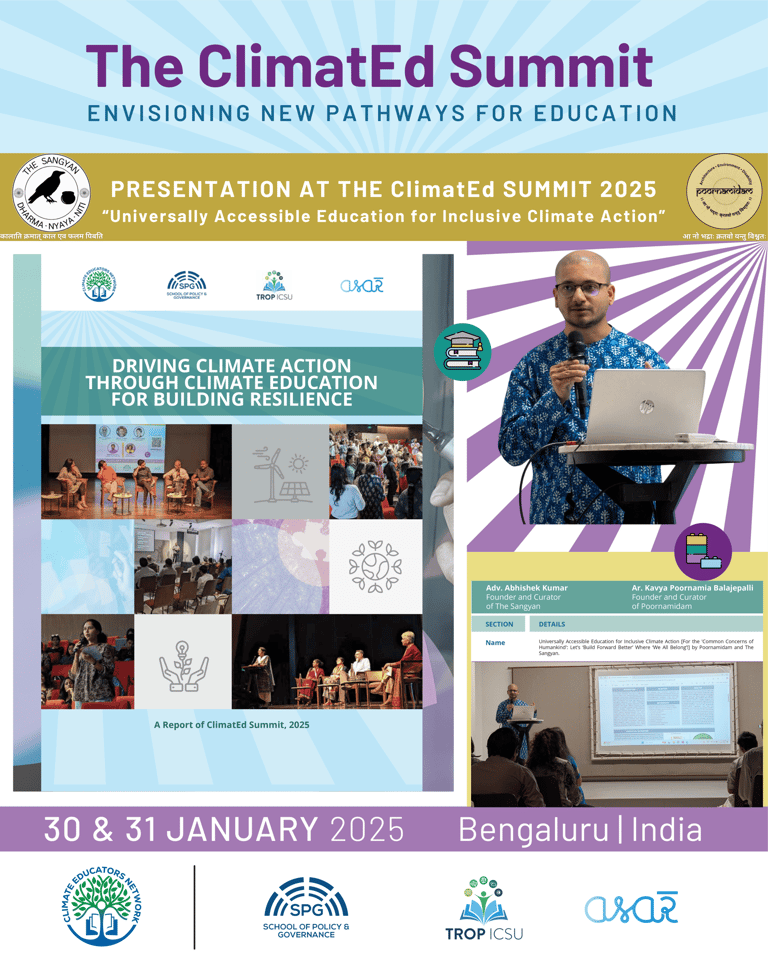
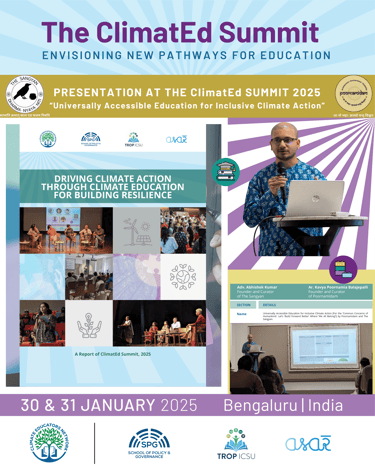
Represented the convergence of inclusive and sustainable voices at the ClimatEd Summit 2025 — "Envisioning New Pathways for Education" — hosted by the Climate Educators Network, in partnership with the School of Policy and Governance, Asar, TROP ICSU, and SPJIMR Wise Tech, on 30th and 31st January 2025 at Bangalore International Centre (BIC), Bengaluru (India). The ClimatEd Summit brought together varied stakeholders — government bodies, NGOs, educators, academicians, researchers, advocates, and practitioners to advance climate education. The platform enabled the sharing of diverse perspectives, lived experiences, success stories and best practices that helped in gaining fresh outlooks and actionable insights, fostering collaboration and innovative solutions.
Adv. Abhishek Kumar represented the collaborative initiative by The Sangyan and Poornamidam, and made a presentation on "Universally Accessible Education for Inclusive Climate Action". The presentation emphasised that "universally accessible education is sine qua non in achieving inclusive climate action" and highlighted that to address the 'Common Concerns of Humankind' (Re, Sustainable Development Goals, Triple Planetary Crisis, and Polycrisis): we shall ‘Build Forward Better’ (Climate-Resilient and Sustainable) Where ‘We All Belong’ (Equitable, Inclusive, and Universally Accessible) to attain inter-generational equity and justice.
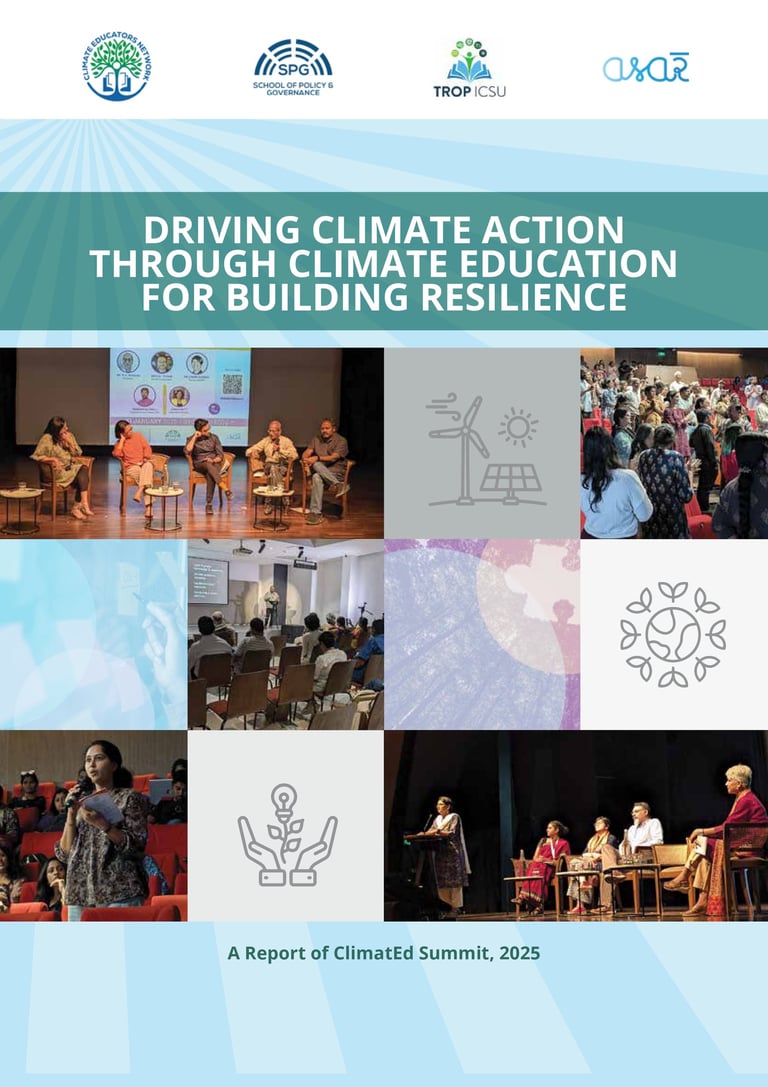
We are also delighted that the ClimatEd Summit Report titled "Driving Climate Action Through Climate Education for Building Resilience: A Report of ClimatEd Summit 2025" incorporated the detailed article in the compendium section covering our presentation titled "Universally Accessible Education for Inclusive Climate Action (For the 'Common Concerns of Humankind': Let’s ‘Build Forward Better’ Where ‘We All Belong’!)". Therein, the article covers the following sections and details about our presentation — Name, Aims and Objectives, Background, Justification, Description of Project/Activity, Theory of Change, Learnings and Challenges (Key Findings, Key Learnings and Key Challenges), and Contribution.
We thank the organisers, speakers, co-presenters, participants and everyone else involved for advancing such a rich śāstrārtha on climate education, inclusive climate action, education policies, budget and beyond. We are hopeful to have made a Ramayana’s Squirrel-esque contribution to the cause of inclusive climate education by catalysing, nudging and triggering a narrative shift towards related policy dialogues and discussions. We also look forward to logical conclusions as follow-ups of the summit to ensure we 'leave no one behind'.
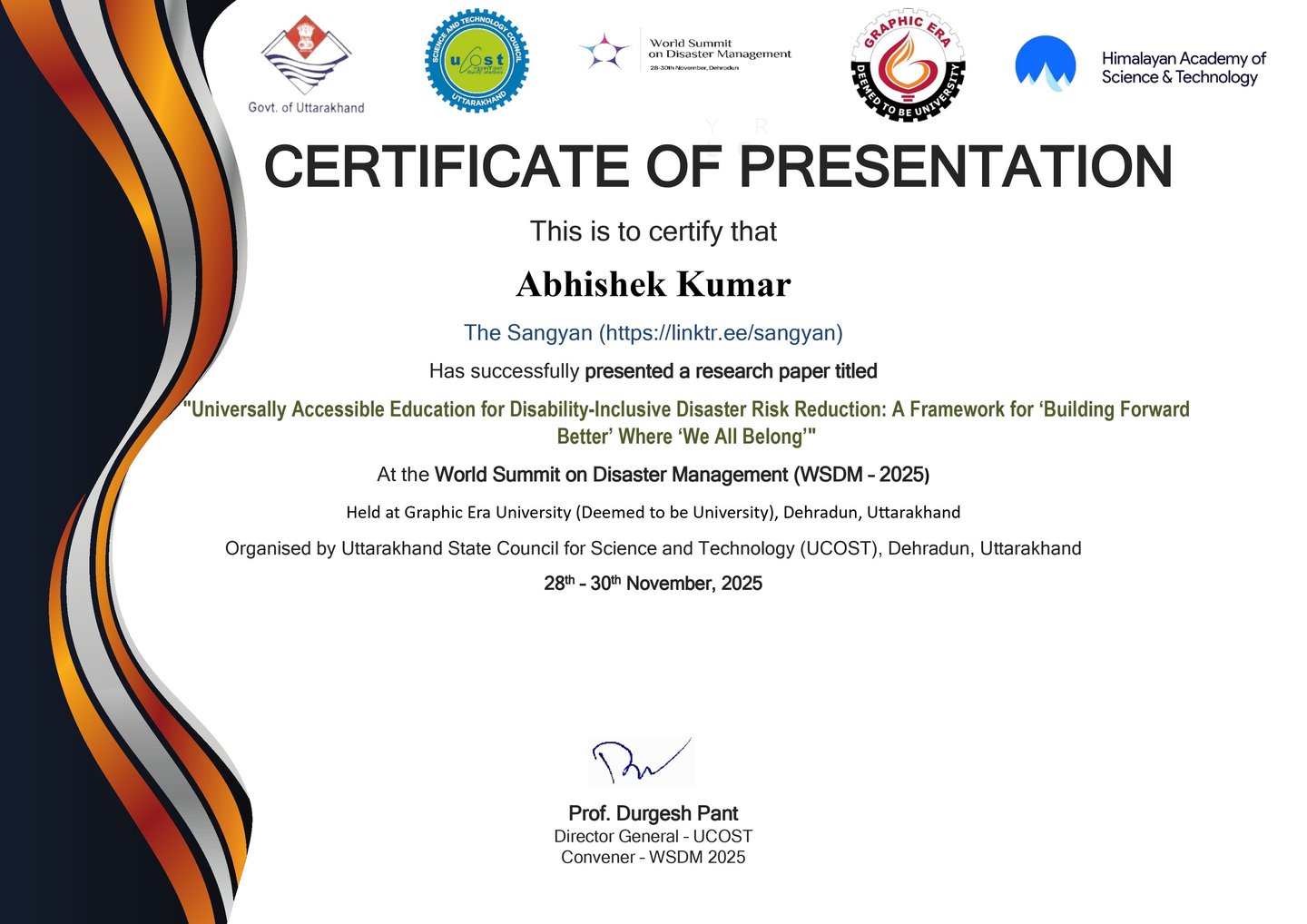
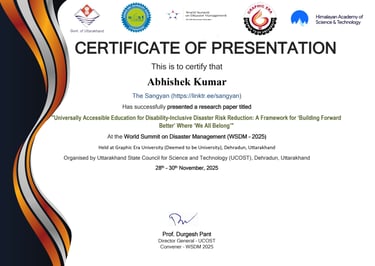
Certificate of Participation: Successfully presented a research paper titled "Universally Accessible Education for Disability-Inclusive Disaster Risk Reduction: A Framework for ‘Building Forward Better’ Where ‘We All Belong’" at the World Summit on Disaster Management (WSDM – 2025) held at Graphic Era University (Deemed to be University), Dehradun, Uttarakhand. Organised by Uttarakhand State Council for Science and Technology (UCOST), Dehradun, Uttarakhand (28th – 30th November, 2025)
Contact Us
abhishek.thesangyan@gmail.com (Founder) thesangyan.in@gmail.com (Organization)
Linktree: https://linktr.ee/sangyan and
https://linktr.ee/thesangyan